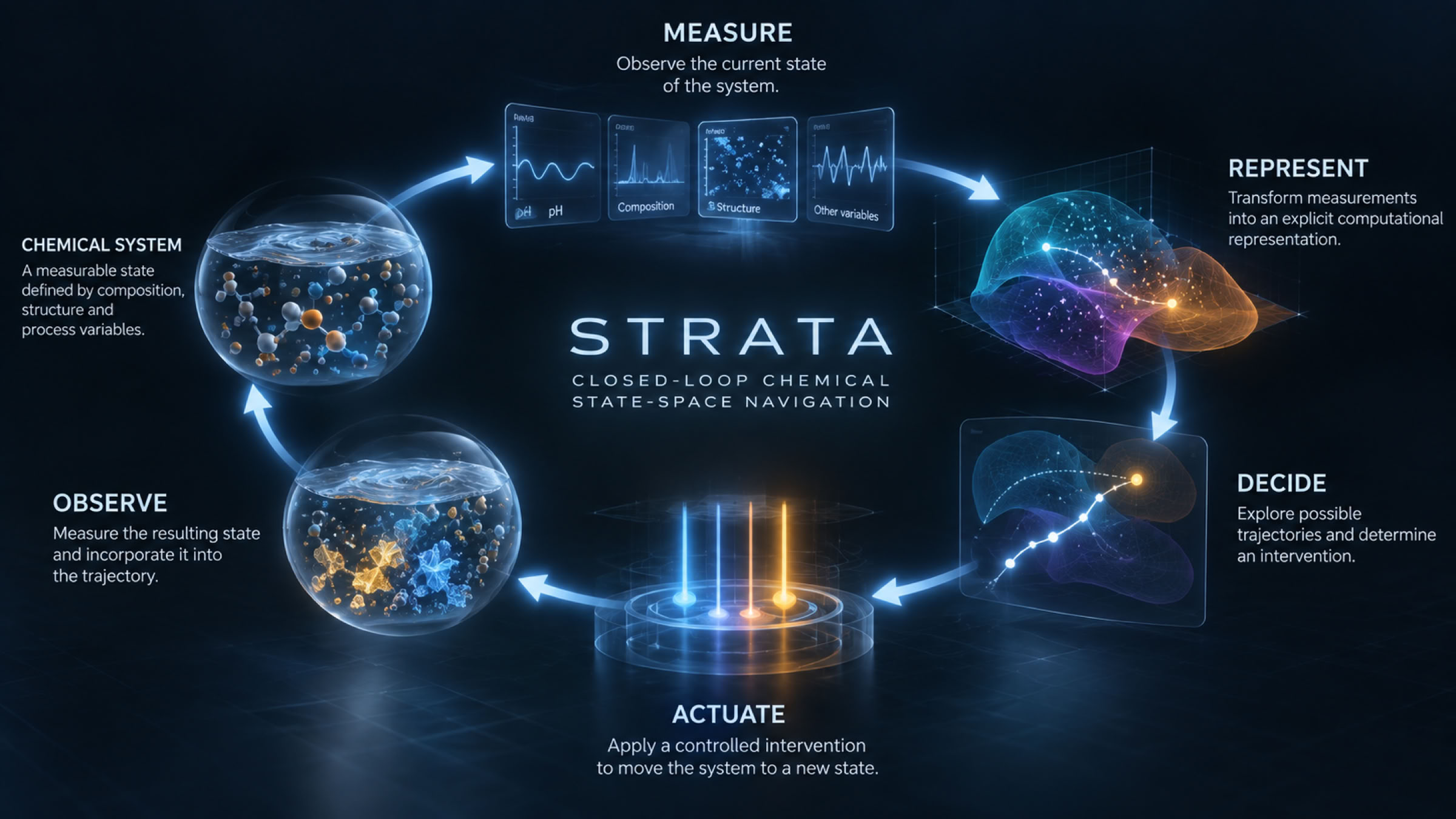
Introducing STRATA: Bringing State-Space Navigation Into the Physical World
STRATA is our experimental platform for navigating chemical state-space. STRATA combines measurement, computation and physical control in a closed loop. The system measures the current chemical state, determines an intervention, applies that intervention, observes the resulting state, and repeats the process. Each cycle produces information about not only the resulting outcome, but the trajectory used to reach it.
Conventional chemical processes are typically developed as predefined sequences of conditions and operations. STRATA approaches the problem as dynamic navigation: measure the current state, apply a controlled intervention, observe the response, and determine the next step. The resulting trajectory becomes part of the experimental knowledge of the system.
STRATA offers three levels of exploration:
01 — PROCESS DISCOVERY
Known destination. Unknown or improved trajectory.
Discover better pathways for separating, refining, producing, or transforming known materials.
02 — FUNCTIONAL-MATERIAL DISCOVERY
Known building blocks. Unknown optimum.
Explore compositions, structures and processing trajectories for materials with improved or previously unrealized functional properties.
03 — NOVEL COMPOSITION-OF-MATTER DISCOVERY
Unknown destination.
As STRATA progresses from Level 1 to Level 3, the problem changes from finding a better route to a known destination to discovering destinations that were unknown in advance.
Conceptual chemical state-space. A material system can follow different trajectories as controllable variables change, potentially entering regions where different materials, phases, or recovery pathways become accessible.